Perched on a rocky outcrop overlooking the town of Cheltenham is the crooked pillar known as the Devil’s Chimney. Legend has it that the lord of darkness was so enraged by the godly people of Gloucestershire, that he sat atop Leckhampton Hill to throw stones at parishioners on their way to church.
Eventually the stones were turned back upon him, driving him beneath the hill to be trapped beneath the large pillar where he remains in perpetuity. It is said that on a dark night, smoke rises from the chimney as the Devil rages below, plotting his revenge.
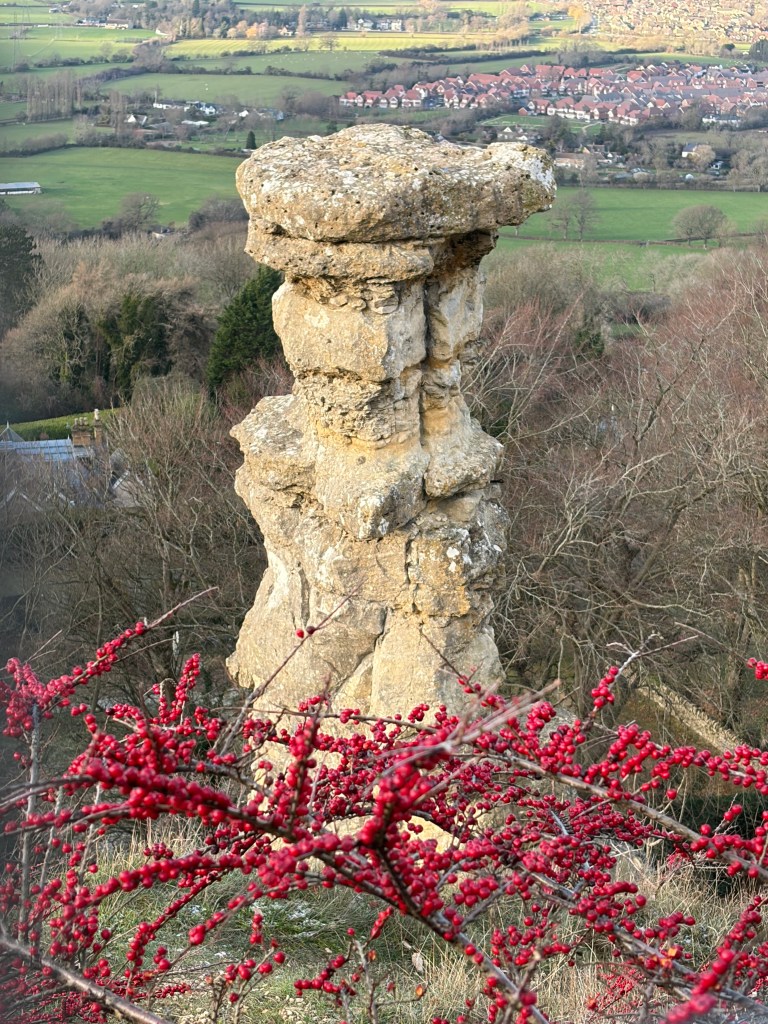
An earthquake in 1926 may have been an attempt at his escape, but the chimney stood firm. The damage sustained was later repaired, with townsfolk too superstitious to leave the chimney at risk of collapse from the elements.
However, this didn’t stop a local mountaineering club from ascending the monument to see how many of them could stand atop the summit. Rather fittingly the total numbered thirteen, all of whom survived to tell the tale.
Whilst the folklore is compelling, the Devil’s Chimney is likely the work of mortal men rather than anything supernatural. Quarrying in the 19th Century led to the construction of tramlines to move stone down the hill. As the cliffs were excavated to accommodate a new incline, a pillar of rock was left isolated, perhaps intentionally by some workers with a devilish sense of humour.
Quarrymen weren’t the only ones to shape this landscape, with evidence of human activity dating back thousands of years. Above the Devil’s Chimney is Leckhampton Hill Fort, an Iron Age fortification offering commanding views across the region.
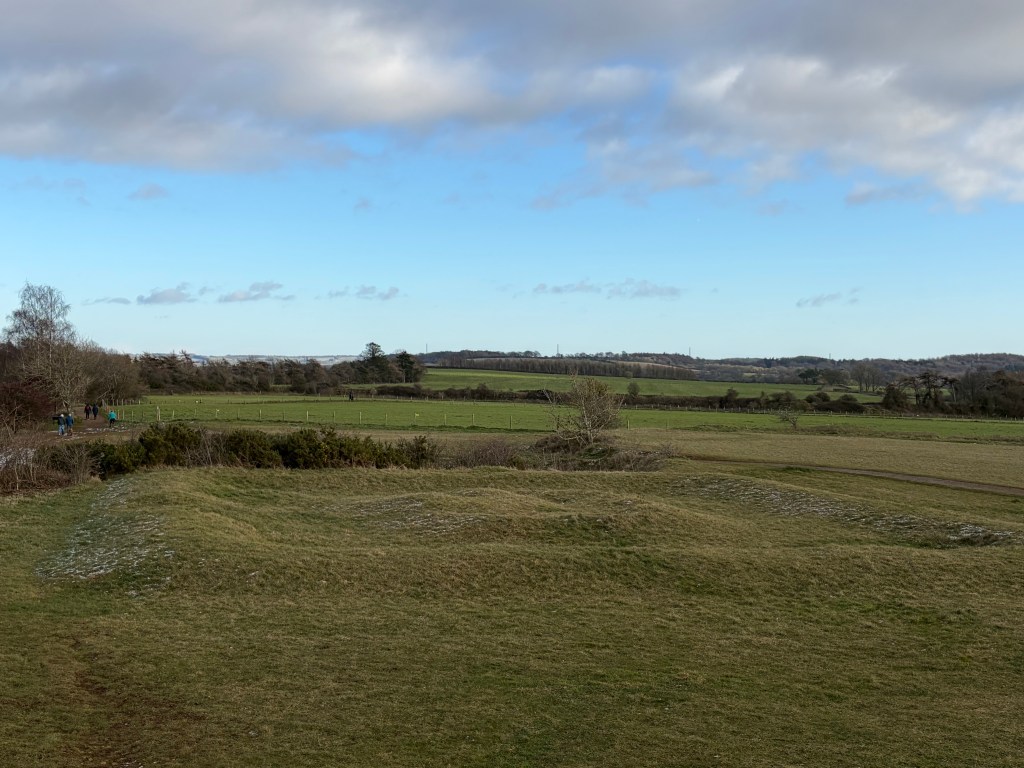
Standing at the trig point within the fort, an unusual round barrow can been seen situated within a square enclosure. Excavation confirmed its use as a burial site, possibly by the Dobunni tribe who settled across the Cotswold Escarpment.
The first quarries on the hill were likely ancient, but as the spa town of Cheltenham developed in the 18th century, the hill’s resources were extracted on a more industrial scale with stone used for local buildings and lime production.
It would turn out that the Devil wasn’t the only villainous character to reside on Leckhampton Hill. The public nearly lost the right to roam across the land due to the actions of Henry Dale, who took ownership of the quarries in 1894.
His greed was met with outrage by local residents, which culminated in a riot in 1902, led by a group known as the Leckhampton Stalwarts. Fencing and even a stone cottage were torn down to assert the right to roam over the land. Legal proceedings followed, which led to the recognition of some historical footpaths.
The quarry eventually passed into different ownership and later business ventures failed, whether the result of devilish mischief or changing circumstance. The town council were able to acquire the land in 1927, securing it for future generations to enjoy.
Today, many pilgrims pass through walking the Cotswold Way. Some of those brave enough to make a detour to the Devil’s Chimney will leave coins on the rocks as offerings, hoping to avoid the Devil’s wrath and encourage his continued slumber beneath the hill.
Visiting Information
Leckhampton Hill is registered common land with the right to roam freely over the full area. The formal footpaths form part of the Cotswold Way national trail.
The Devil’s Chimney can be approached from multiple directions. The shortest but steepest route can be accessed via Hartley Lane car park, with a longer but more accessible route further up the hill at Brownstones car park.
 Strange Stroud
Leave a comment