The fair maids of February herald the arrival of Spring, serving as symbols of hope and renewal after a long period of cold and darkness. Their piercing green leaves and delicate white flowers triumphantly burst through the frozen ground to signify the end of the winter months and the start of brighter days.
The annual display at the Painswick Rococo Garden is particularly impressive, with over five million bulbs carpeting the grounds and woodland. The garden is home to fifteen known snowdrop varieties, including Galanthus Atkinsii, one of the tallest and earliest flowering hybrids, discovered by estate worker James Atkins in the 1800s.
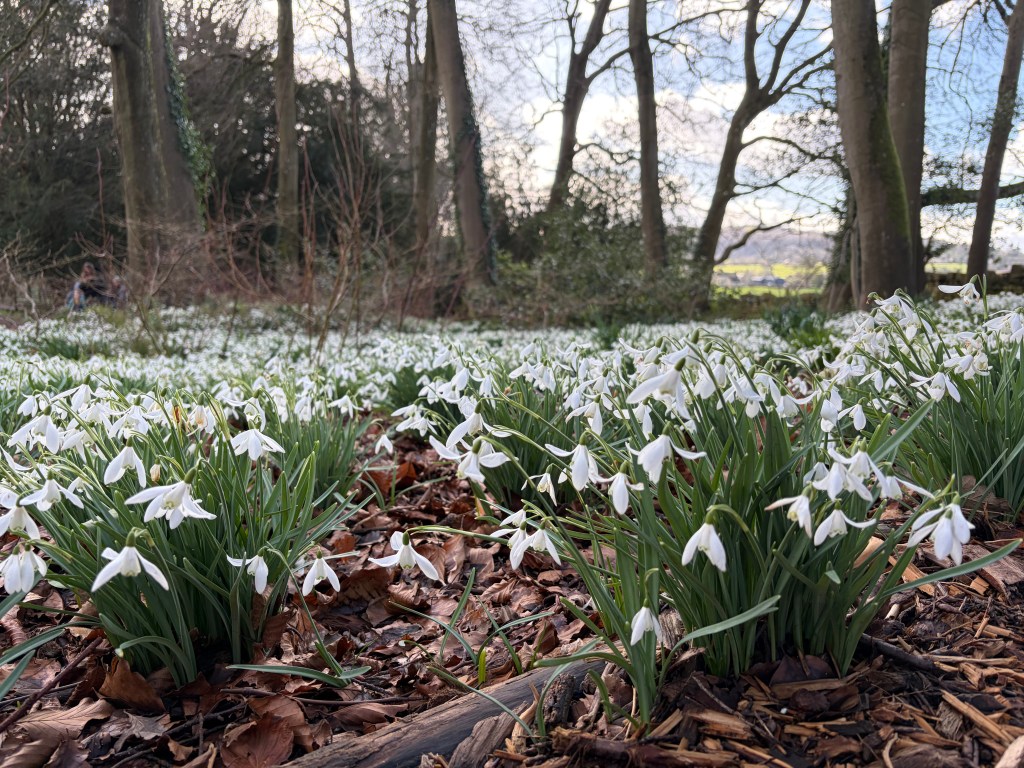
Snowdrops are now a universal sight across the British Isles, but they are native to mountainous regions in southern Europe and the Middle East. It is thought snowdrops first arrived on our shores in the 16th Century, bringing with them rich and varied folklore.
In the Celtic tradition, snowdrops are associated with Brigit, the goddess of fertility and healing. The Christian Saint Brigid shares similar characteristics and her feast day is marked on the 1st February or Imbolc, the midpoint between the winter solstice and spring equinox, around the time bulbs are in full bloom.
Imbolc is derived from an old Gaelic word meaning ‘ewe’s milk’ and the snowdrop genus Galanthus translates as ‘milk flower,’ symbolising purity and the return of light to the earth. The flowers are also associated with the festival of Candlemas and are often used to decorate churches during the celebration.
According to Christian legend, snowdrops were created to offer hope to Adam and Eve following their exile from paradise. A sympathetic angel caught falling snowflakes and transformed them into living flowers, offering them as a sign of light and renewal to carry into a new and uncertain world.
Snowdrops were first recorded growing in monastic gardens, where they were used for medicinal purposes, including as a common cure for headache. It seems their healing properties have been known since antiquity, as in the tale of Odysseus, the snowdrop is thought to be the magical herb moly, used to counteract the poison of forgetfulness brewed by the witch Circe. Interestingly, in modern medicine, the compound galantamine is extracted from snowdrops to treat memory problems.
The planting of snowdrops in monasteries and churchyards may have led to a different association as an omen of death and misfortune. Old superstitions warned that bringing snowdrops into the home would turn milk sour and spoil eggs. The Victorians planted snowdrops at gravesides but feared that if a snowdrop was plucked from the ground and brought across the threshold, further death would befall the family within the year.
In another Greek myth, snowdrops bridge the land of the dead and living, signifying Persephone’s return from the underworld and the imminent arrival of Spring and the regeneration of the earth, offering both hope and consolation.
The mixed symbolism of the snowdrop makes it an a fitting messenger for the transition between seasons and the repeating cycle of death and regeneration. Its defiance against the cold and frost serves as a potent reminder that darkness will give way to light, as illustrated in George Wilson’s poem the origin of the snowdrop:
“And thus the snowdrop, like the bow
That spans the cloudy sky,
Becomes a symbol whence we know
That brighter days are nigh…”
Visiting Information
The snowdrops at Painswick Rococo Garden are usually at their best in early to mid February. See the website for updates about the best time to visit.
 Strange Stroud
Leave a comment